Reusable analysis workflow
Functional Module Evidence Mapping
A reviewed term-to-module map organizes enrichment records into manually curated functional categories, linking them to traceable gene annotations, heatmap matrices, and Cytoscape-ready node attributes.
The demonstration below uses synthetic genes and terms. It illustrates the workflow, not a biological finding.
Manual review step
Enrichment Mapping Reviewer
Inspect source terms and genes, record module assignments with a rationale, and export a traceable term-to-module mapping before running the workflow.
Process
- 01
Validate inputs
Check the node list, enrichment files, module dictionary, and reviewed term-to-module mapping.
Input tables - 02
Trace evidence
Connect included terms to genes and modules. Report unmatched terms and genes outside the node list.
Long evidence table - 03
Prepare annotations
Build gene annotations and binary or frequency matrices. Keep manual display choices separate from source evidence.
Final annotation + matrices - 04
Export
Prepare Cytoscape node and color tables; optionally render a heatmap with base R.
Import-ready tables + figure
Synthetic example
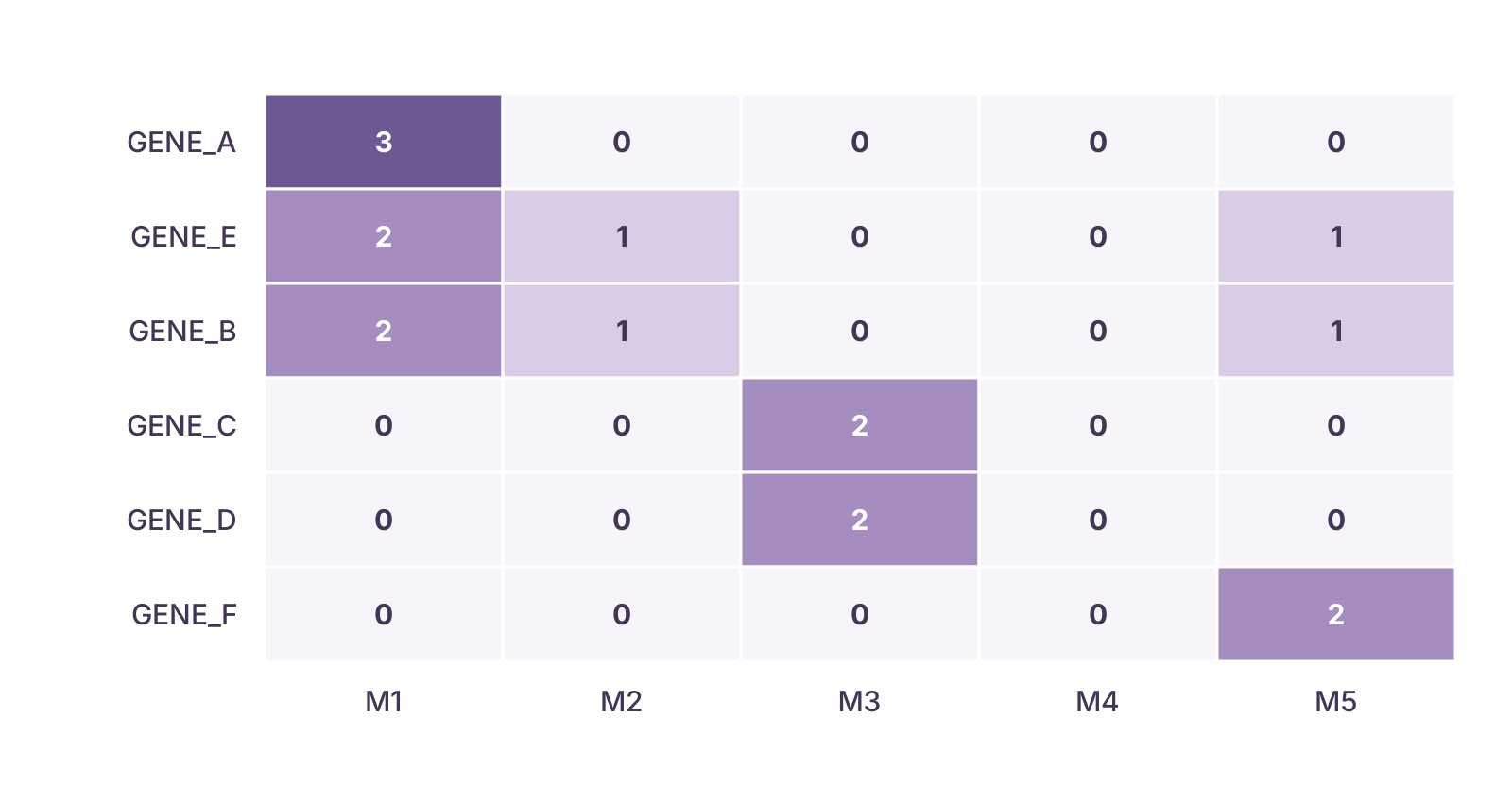
Mapped-term frequency matrix
Each cell counts distinct included terms mapped to a gene and a functional category.
Deliverables
What the workflow exports
Evidence
Gene–term–module records, unmatched-term reports, and a final annotation table.
Heatmap data
Binary and term-frequency matrices with an explicit gene order; a figure when R is available.
Cytoscape import
Node attributes and a module/color lookup, ready to join by gene identifier. Try the browser import builder with a final annotation CSV.
Provenance
Inputs used, file checksums, step status, and run metadata for later review.
Scope and interpretation
The workflow accepts either the four expected PPI/STRING enrichment tables or one or more custom enrichment tables. A researcher supplies and reviews the term-to-module mapping. The workflow does not discover modules, apply enrichment significance thresholds, build a network, or operate Cytoscape itself. The reviewer supports manual term mapping before the workflow runs; the import builder converts a completed final annotation table into import CSVs.