Method
The planned analysis uses earlier behavioral and physiological measurements to predict subsequent task performance. [1]
Under refinement
Research questions defined; candidate features and evaluation protocol under refinement.
Sustained attention · Ongoing research
I am investigating whether behavioral and physiological data can predict subsequent performance in a sustained-attention task. The project brings together behavioral measures, pupillometry, electrocardiography (ECG) and electroencephalography (EEG). My goal is to understand which sources of information support prediction, how models generalize across participants, and whether combining modalities improves on simpler baselines.
My work spans literature review, signal processing, feature extraction and the design of model validation.
Research questions
Methodological overview
Open figure
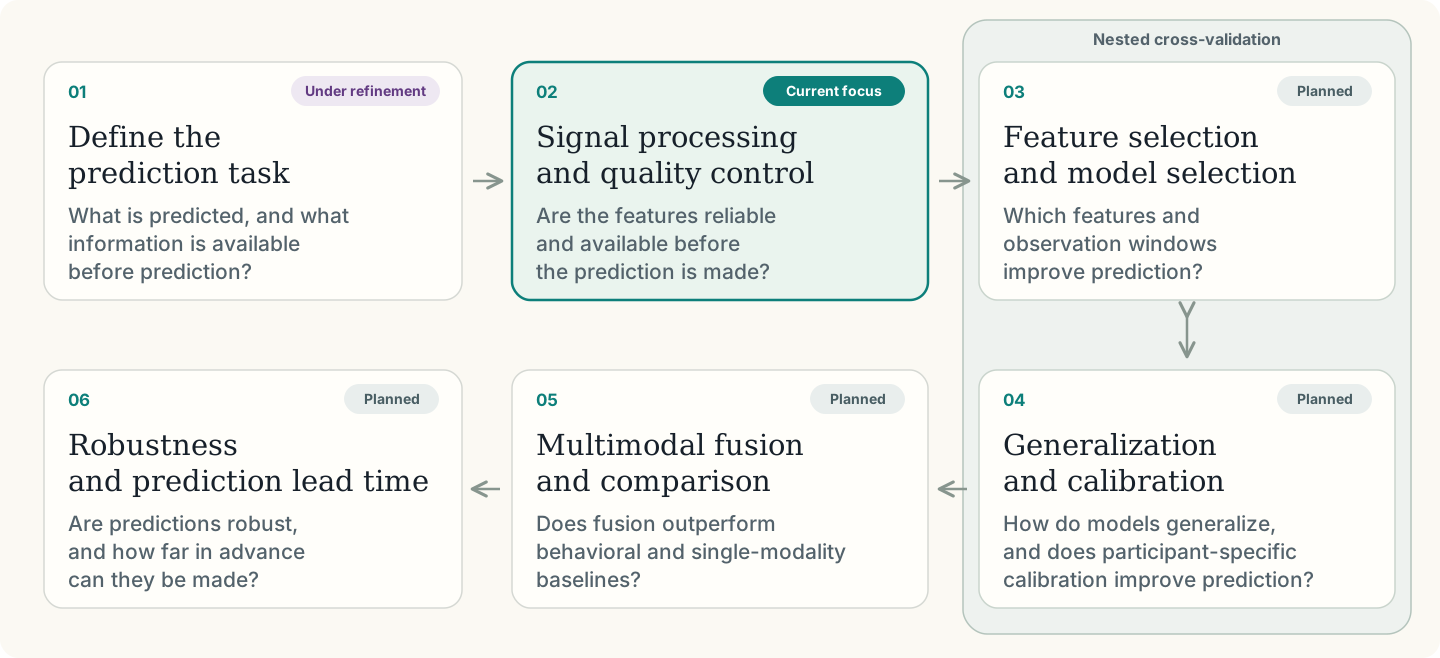
Which outcome is predicted, and what information is available at prediction time?
The planned analysis uses earlier behavioral and physiological measurements to predict subsequent task performance. [1]
Research questions defined; candidate features and evaluation protocol under refinement.
Are the features reliable and available before prediction?
Physiological recordings are aligned with behavioral events. Preprocessing and feature extraction include checks for artifacts, missing data and agreement with reference measurements. [2]
Signal-quality checks, reference comparisons and assessment of feature availability.
Which features and observation windows improve prediction?
The planned analysis uses nested cross-validation for feature and model selection. Data-dependent preprocessing is fitted on training data, and performance is assessed on held-out data. [3]
Feature discovery and model selection within the common validation design.
Does prediction generalize to new participants, and does calibration help?
The planned evaluation compares single-modality models with and without participant-specific calibration. Calibration uses earlier data from new participants; later observations are reserved for testing. [4]
Participant-level evaluation under explicit training, calibration and test-data boundaries.
Does multimodal prediction improve on behavioral and single-modality baselines?
The planned analysis compares behavioral, single-modality and multimodal models on matched participants and observations. Ablation analysis evaluates each modality's predictive contribution by removing it and refitting the model. [5]
Comparative evaluation after the common feature-validation and single-modality analyses.
Are predictions robust to confounding, and how early can they be made?
The planned analysis tests for confounding and evaluates predictive performance at different lead times. Prediction lead time is evaluated separately from observation-window length. [4]
Control analyses specified during study design; systematic evaluation still to come.